Best Books of 2024

Happy 2025! (Yeah, ok, we’re already a month into the new year, but I didn’t have time to properly sum up my 2024 reading until now).
For a while now I’ve been sharing on IG all the books that I read; however, I fell behind late in the year and then, when I wanted to sum up my reading and do a “best of” for 2024, I found myself wanting more space to write, so I thought I’d give reviving this little newsletter of mine a go.
Late in 2023 I saw someone (somewhere on social media) who was keeping a visual bookshelf and I thought it looked fun and crafty so that’s how I kept track of my books last year. Here’s the final result: 130 books.
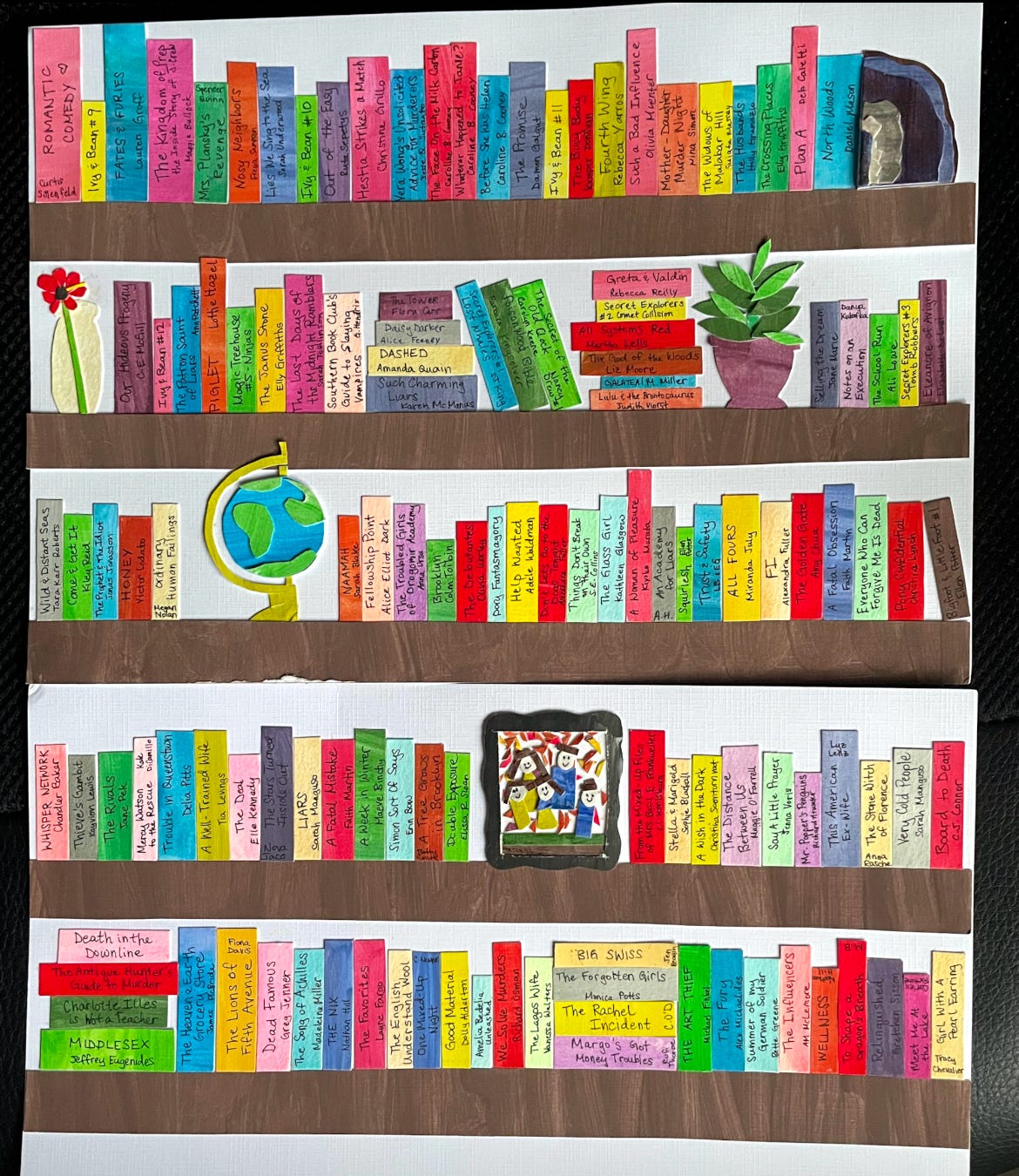
Ok, buckle in. This is a long one. Here are the categories I’m using, in case you want to scroll ahead:
Favs of 2024
Best of 2024 If You Just Want Something Fun to Read…
Best of Non-Fiction
I spot a trend here…
Best Rereads
Favs of 2024
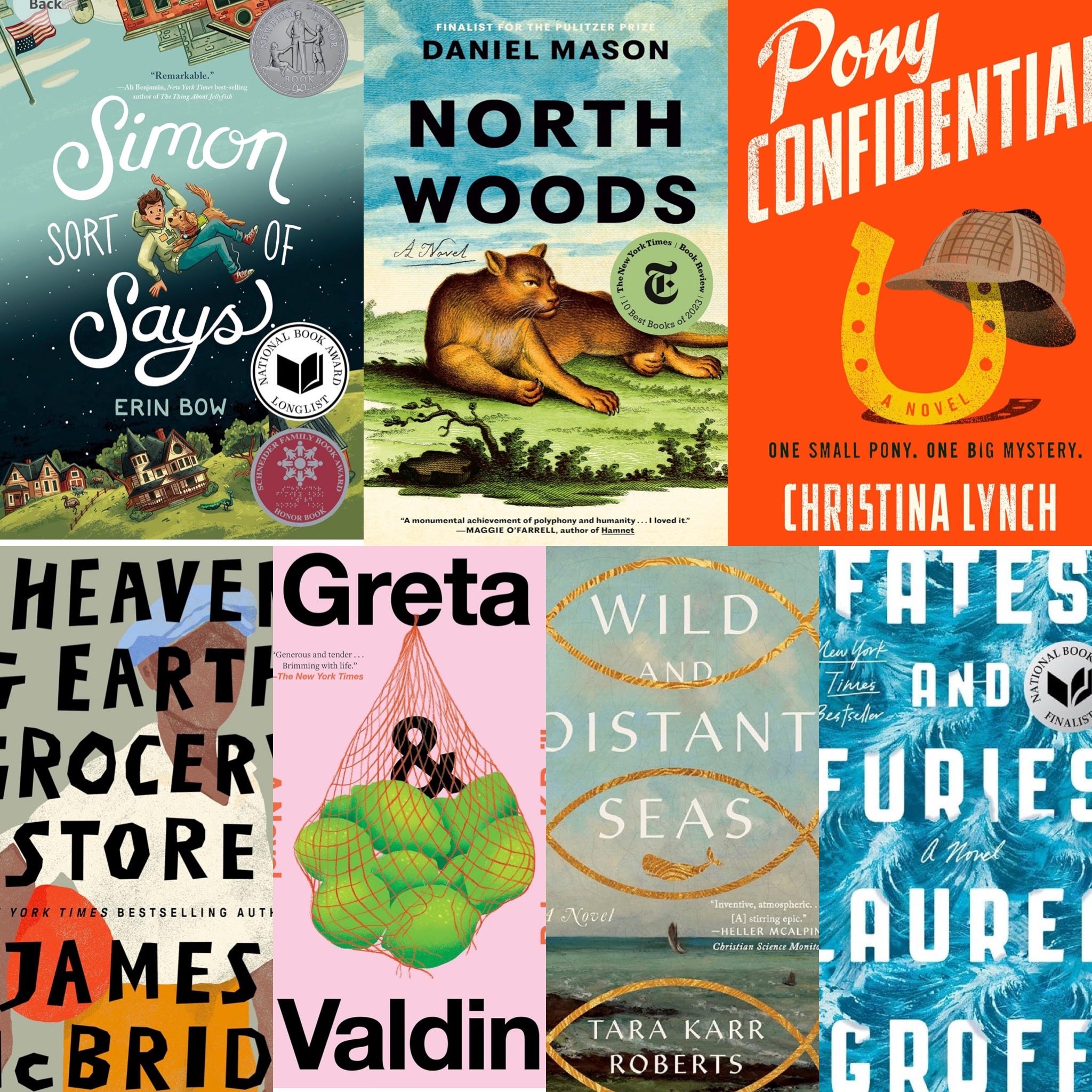
Simon Sort of Says (by Erin Bow)
Had this recommended to me as “the best middle grade book I read last year” so I immediately checked it out. It was so, so good. It was gut-wrenching — I cried multiple times reading it — but also, remarkably, managed to be really funny too and had highly memorable characters. I definitely recommend it, even if you don’t usually read middle grade.
North Woods (by Daniel Mason)
I’ll admit it took me a bit to get into this one — I think because I went in cold, not having any idea what it was about and it took me a while to get into the flow of it. But once I did, it was utterly engrossing. Beautiful and weird and lyrical, it’s definitely a book that has stuck with me. The story spans centuries and numerous lives — human and nonhuman (the beetle chapter was a particularly fav!) — all connected by a single house deep in the woods of New England. It’s one of the most deeply environmental books I can recall reading, and it revels in the natural world, history, and language. Not a particularly light or easy read, but definitely worth the effort.
Pony Confidential (by Christina Lynch)
I only picked up Pony Confidential because I got a free advanced copy, so I was caught off-guard by how much I enjoyed this oddly charming book. It’s a murder mystery (don’t worry, nothing too grim) being solved by a talking pony (as in, Pony is the narrator. He doesn’t actually talk to humans. He does talk to other animals though). Ok, the premise might be strange, but hear me out: Pony is grumpy, clever, and hilarious; the birds and their trickery are funny; and the rat is a great character (I feel like the author must be a fan of Charlotte's Web — it seems like there are some nods to it throughout). And the book just has so much heart. It’s tender and sad and will make you reconsider the bonds between animals and humans. For all its weirdness, this is a book that I still think about frequently, even months later.
Greta & Valdin (by Rebecca Reilly)
Another one that took me a minute to get into, but that I ended up really loving. A story of 20-something siblings Greta and Valdin as they attempt to navigate love, queerness, as well as their multiracial (Maaori-Russian-Catalonian) identity and complex family dynamics. Funny, messy, and charming, G&V is a refreshingly unique book. (I also love its cover!)
The Heaven and Earth Grocery Store (by James McBride)
I love historical fiction, especially books that focus on people/places/moments that have been largely overlooked or forgotten. In Chicken Hill — a dilapidated neighborhood on the margins of Pottstown, Pennsylvania — Jewish and Black communities live side-by-side, their lives often intertwined by the shared struggle of living in a city (and country) dominated by white Christians. Heaven and Earth paints an unforgettable picture of American history that is both difficult to read and impossible to ignore.
Wild and Distant Seas (by Tara Karr Roberts)
The only thing I love more than historical fiction is historical fiction that takes a well-known story and re-centers it on women. A brief mention of a woman in Moby Dick (Mrs. Hosea Hussey who serves Ishmael and Queequeg chowder when they stay at the Try Pots Inn in Nantucket) serves as the springboard for the novel. It begins with Evangeline Hussey (that is, Mrs Hosea Hussey); her encounter with Ishmael and Queequeg, and the choices she makes echo through the stories of her descendants. The story follows traces four generations of women, from mid-nineteenth century Nantucket to Boston, Brazil, Florence, and Idaho (Idaho!). An excellent read, whether or not you’re a fan of Melville. (Full disclosure: I (secondhand) know the author and got a personally signed copy of the book hand-delivered last year when a friend came to visit!)
Fates and Furies (by Lauren Groff)
I’m a big fan of Lauren Groff (Matrix is one of my all-time favorite books) and I really enjoyed F&F. It’s the story of Lotto and Mathilde and their decades-long marriage, but it’s also about art, partnership, and perception. Lotto and Mathilde have a seemingly wonderful, much-envied relationship. Told from different perspectives (the first half is golden-boy Lotto’s take on things, the second half is Mathilde’s truth-revealing story) the novel explores creativity and power, questioning gender expectations and who is allowed to create art.
Best of 2024 If You Just Want Something Fun to Read…
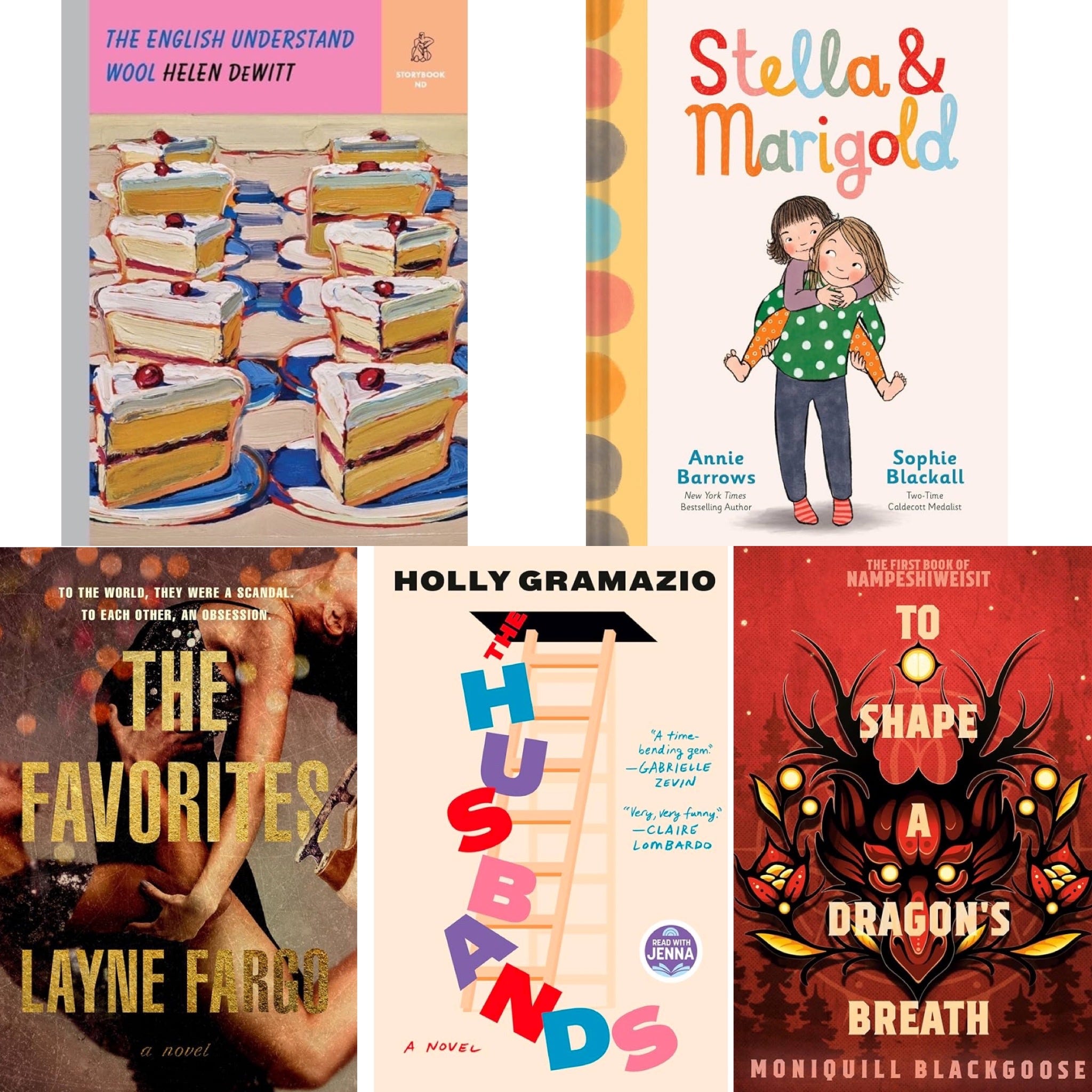
Some quick-fire suggestions:
The Husbands (by Holly Gramazio)
Lauren’s attic begins magically creating an infinite supply of husbands, each of whom offers a different life. With so many options, how is she ever supposed to know who to choose?
The Favorites (by Layne Fargo)
Daisy Jones and the Six meets The Cutting Edge (does anyone else remember that movie? Toe pick!) A documentary-style narrative set in the world of elite figure skating. A fun read.
To Shape a Dragon’s Breath (by Moniquill Blackgoose)
If you want your fantasy books to have dragons but also an Indigenous female protagonist who stays true to her upbringing in a genderqueer community while being forced to attend a school run by Anglish colonizers, this is the books for you!
The English Understand Wool (by Helen DeWitt)
This is just a delightful little bonbon of a story. A super quick and satisfying read.
Stella & Marigold (Annie Barrows (author) & Sophie Blackall (illustrator))
Love it. Charming, funny, random and heartwarming stories of two sisters — Stella and Marigold — and their adventures. An early chapter book, it’s a wonderful book to read aloud with young children. And, of course, the illustrations are a delight (am I biased because I received a signed copy, handed to me directly by the illustrator, before it was available to the general public? (brag!) Perhaps. But it honestly is a really great book.) I’m so glad that there will be more books to come.
Best of Non-Fiction
In a shock twist (I tend to read very little non-fiction in general. I’m much more a fiction reader) I have eight non-fiction titles to include!
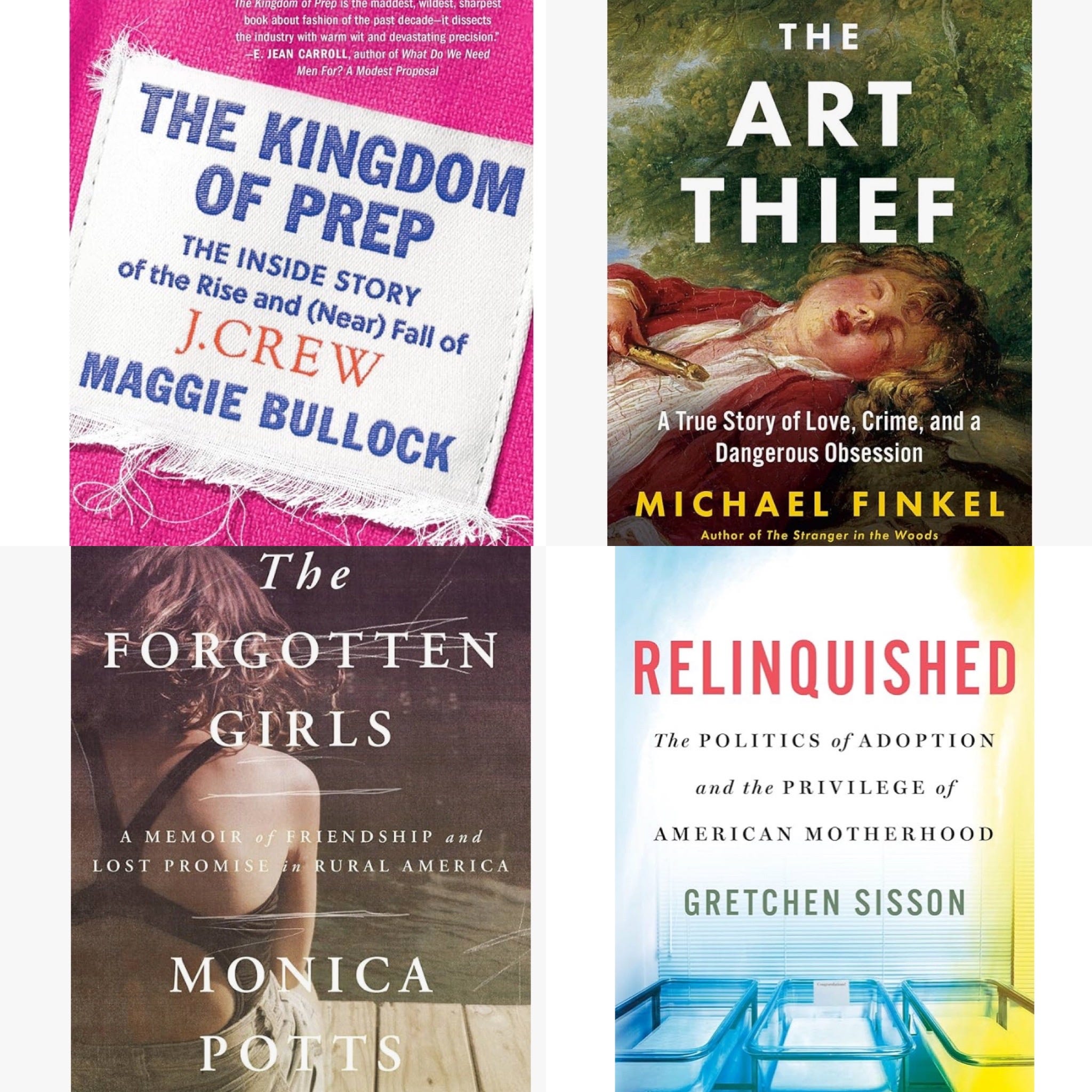
The Kingdom of Prep: The Inside Story of the Rise and (Near) Fall of J. Crew (by Maggie Bullock)
I was surprised how compelling this was. I’ve never even been a huge J. Crew fan. But the book is about much more than one company. It’s about fashion and style, of course, but it’s also a business narrative full of interesting characters, a history of retail, catalogs, and mall culture, and a examination of race/culture/class in American history.
The Art Thief: A True Story of Love, Crime, and a Dangerous Obsession (by Michael Finkel)
I particularly enjoy a true crime story that doesn’t center on violent crimes against other people and this fit the bill. The story of a man who pulled off over 200 art heists across Europe, usually in broad daylight. Unusually, he didn’t steal for profit; he kept every piece in a personal collection (estimated to be worth over $2 billion) stored in his attic bedroom at his mother’s house.
The Forgotten Girls: A Memoir of Friendship and Lost Promise in Rural America (by Monica Potts)
A story of rural America (the author grew up working-class in Arkansas) and its struggles. Potts traces the personal (and very different) trajectories of herself and a childhood friend to examine the ways in which much larger forces — unemployment, education, poverty, drug abuse, lack of reproductive autonomy, racism, sexism, religion (especially evangelicalism) — shape individual lives.
Relinquished: The Politics of Adoption and the Privilege of American Motherhood (by Gretchen Sisson)
I (like many, I suspect) largely viewed adoption as an overall “good thing” but have been questioning this a lot over the last year or so (largely due to listening to/reading stories — from adoptees and birth mothers — that push back on many of our assumptions about adoption). Reading this book has fully convinced me that adoption is deeply complicated and frequently problematic (especially historically, but currently as well). Who is allowed to adopt? Who is seen as not worthy of raising their own children and are thus pushed to relinquish? Sisson’s long-term study centers the voices of relinquishing parents while deftly drawing individual stories back to national issues of (lack of) reproductive rights and a distinctly American lack of support for families.
(Q: Wait! I thought you said you had eight non-fiction books to include? There are only four here. A: correct! Two more of my non-fiction picks are under “Reread” (Don’t Lets Go to the Dogs Tonight and Fi) and two others (This American Ex-Wife and A Well-Trained Wife) are under “I spot a trend here”).
I spot a trend here…
Ok, so I’m not necessarily recommending all of the books listed here, but I wanted to include them all because they are examples of a definite (micro?)trend I’ve noticed recently: woman (usually in her 40s, usually a mother) leaves her (secretly or not-so-secretly) soul-destroying marriage. But these aren’t just divorce stories, they’re get-divorced-and-questions-the-entire-institution-of-marriage stories. They explore the (often quite painful) reality of what changes when a woman becomes a wife and then a mother. And these stories must be resonating for a lot of people or these books wouldn’t be getting published. I’m here for questioning the institution of marriage, for scrutinizing gendered expectations in the household, for pushing back against the constant, invisible, emotional labor women are expected to do and I think it’s interesting to note this particular publishing trend and to reflect on what it means on a societal level.
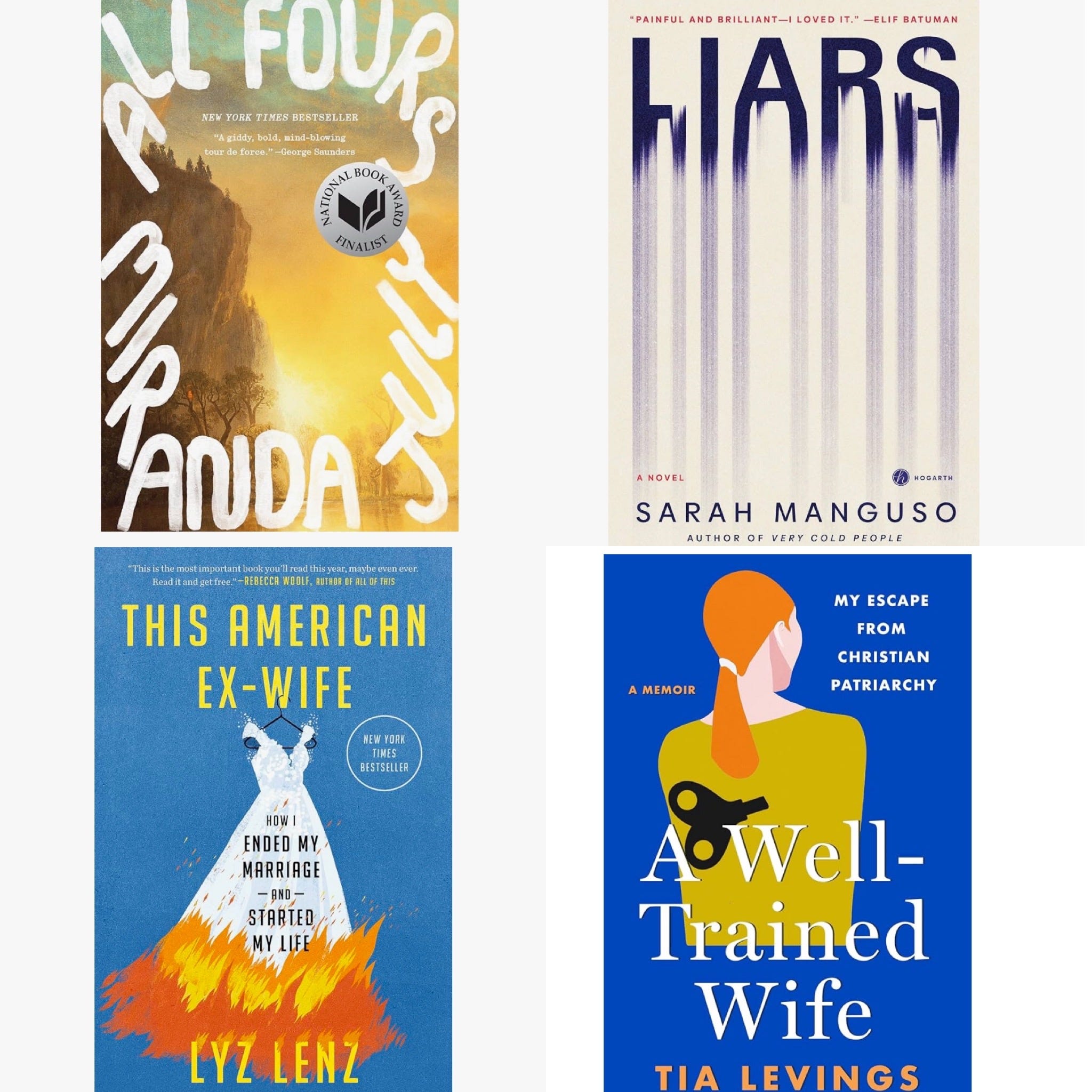
All Fours (by Miranda July)
Omg, this book was SO HYPED and recommended to me in so many places and by so many people and it was a National Book Award finalist and I had to wait so long to get a copy from the library and then…I was mostly disappointed? Not fully. I can kinda see the hype. And I’m glad I read it. It just didn’t live up to the massive praise, for me. Or I just didn’t expect such large portions of it to be about lavishly decorating a hotel room. It was fine, I guess. But of the books on this sublist, this is the last one I’d actually recommend reading. [N.B. fiction]
Liars (by Sarah Manguso)
Ok, this was what I expected All Fours to be (and I think it’s much, much better. I’d definitely recommend this over AF). It’s the slow burn of constant gender expectations and then the explosive anger of a woman — and an artist — who refuses to be completely erased, to be subsumed by her relational identities of wife and mother. (I enjoyed this author’s writing so much I immediately checked out her book Very Cold People which is quite dark, but I also recommend it). [N.B. fiction]
This American Ex-Wife: How I Ended My Marriage and Started My Life (by Lyz Lenz)
I’ve read Lyz Lenz’s writing for years now and have always really enjoyed her take on things, and this book is no different. It is, in a lot of ways, a non-fictional counterpart to the fictional Liars, with a similar deep questioning of gender politics in contemporary (American, heterosexual) marriage. TAEW, being non-fiction, however, delves a lot more into the research, interweaving the factual (the history of marriage and statistics about marriage/divorce, etc.) with her personal story. What I think is so great about Lenz/this book is that it’s such a different take on divorce. She refuses the narrative that divorce is shameful, or sad, and is instead joyful and unapologetic about her divorce. [N.B. non-fiction]
A Well-Trained Wife: My Escape from Christian Patriarchy (by Tia Levings)
Tia Levings is another creator I’ve followed for a while, so I was excited to pick up her book. A Well-Trained Wife shares a story of gender politics and marriage taken to an extreme. As a young wife in the fundamentalist Quiverfull movement, Levings tries to be an ideal wife and mother but struggles to maintain the outward appearance of an ideal, wholesome family when, in fact, she and her children are suffering abuse at home. Submission, isolation, silence, and strict discipline are baked into the fundamentalist movement, making it even more difficult for Levings to escape. This book is much more harrowing than the others on this list, but also offers such an important insight into fundamentalism that it’s definitely worth reading. [N.B. non-fiction]
Best Rereads
You’ve likely heard of these books. And you don’t need me to tell you that Barbara Kingsolver is a great author. Still, in a year of often-disappointing books, it was really nice to reread some familiar titles and to revisit some all-time favs.
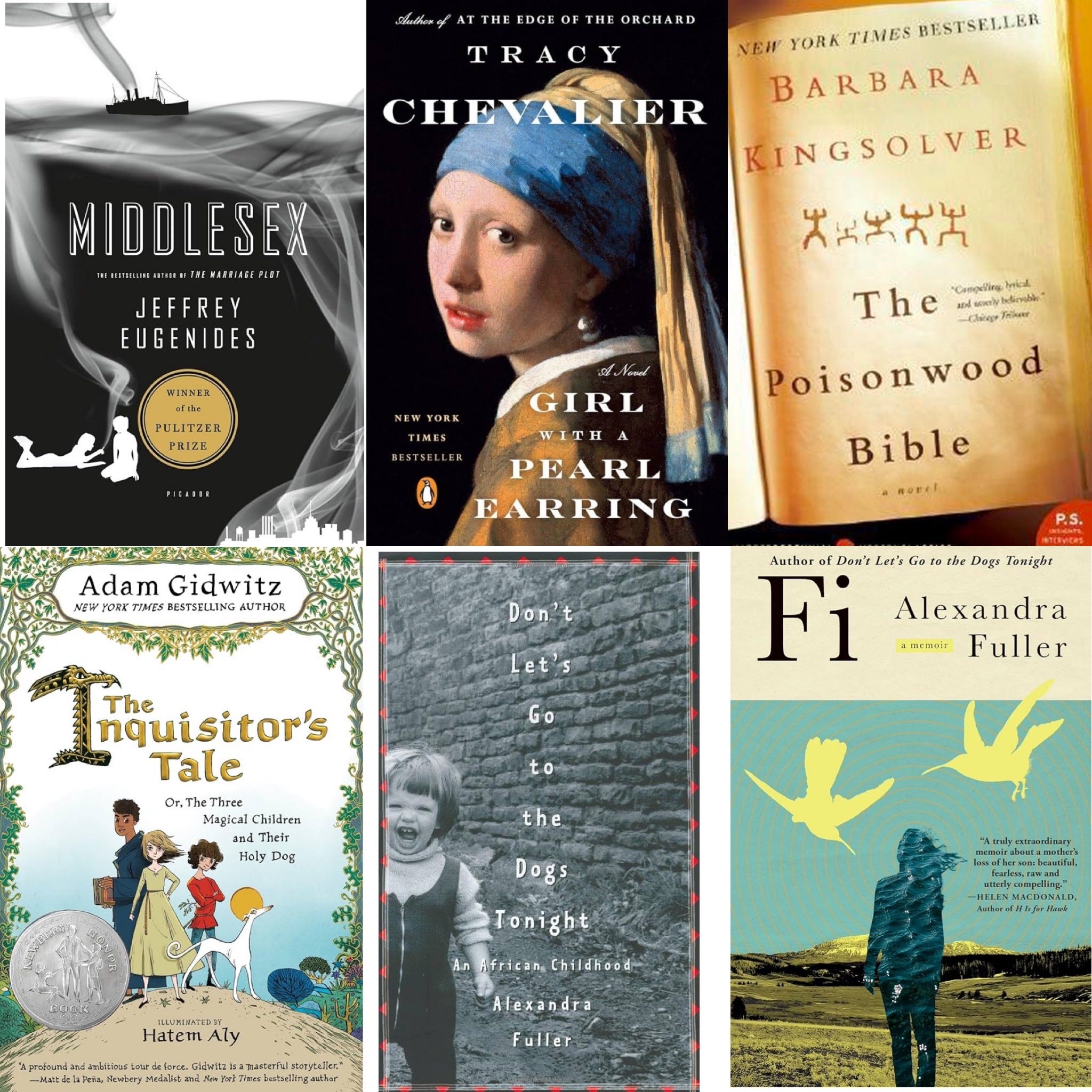
The Poisonwood Bible (by Barbara Kingsolver)
Still an excellent read. If, for some reason, you’ve not yet read it, I highly recommend picking it up.
Middlesex (by Jeffrey Eugenides)
Ok, “Middlesex” has long been one of my favorite books and, back in the early ‘00 I read it numerous times (and even taught it). I had been wanting to reread it for a while but also feared (and strongly suspected) that it wouldn’t hold up to my 2024 scrutiny. I wondered if I should just leave it alone so that I could keep a good memory of it. But, I was low on reading material in English so I picked it up. And I’m delighted to report: IT’S STILL SO SO GOOD! Just a gorgeously written, expertly crafted story. (Honestly, I’m stunned that a cis, white man wrote something like this in 2001!) If you haven’t read it, read it! If you haven’t read it in a long time, it’s worth rereading! It remains up there in the pantheon of my all-time favorite books.
The Inquisitor’s Tale: Or, The Three Magical Children and Their Holy Dog (Adam Gidwitz (author) Hatem Aly (illustrator))
I adored this book back when I first read and I was delighted to get to read it aloud with my 11-year-old (although it did require many, many pauses to explain all sorts arcane topics). It’s a stunningly-crafted story that expertly weaves the silly (a farting dragon) with the heartbreaking (rampant anti-Semitism and book burning). Also, don’t let the fact that this is a middle-grade book hold you back — it’s an excellent read for adults as well.
Girl with a Pearl Earring (by Tracy Chevalier)
I reread this book — set in Delft — when I was staying in Delft for a few days. I remember really liking it when I first read it, and I still enjoyed it even though it was more surface-level than I had remembered. Mostly it was fun to read all the setting descriptions and match them to places I could then go visit.
Don’t Lets Go to the Dogs Tonight (with bonus book Fi) (by Alexandra Fuller)
I had coincidentally just picked up Don’t Lets Go to the Dogs Tonight to reread after many years when I saw that Alexandra Fuller had another book coming out: Fi. I immediately checked it out and was promptly gutted (it’s about the unexpected death of her twenty-one year old son). Not an easy read, by any means, but beautiful in its rawness. Fuller has led quite a fascinating life and I definitely recommend reading her books.
Phew. Cheers to you if you made it this far! With any luck I’ll be back soon with a “what I read in January” summary.